Nurses
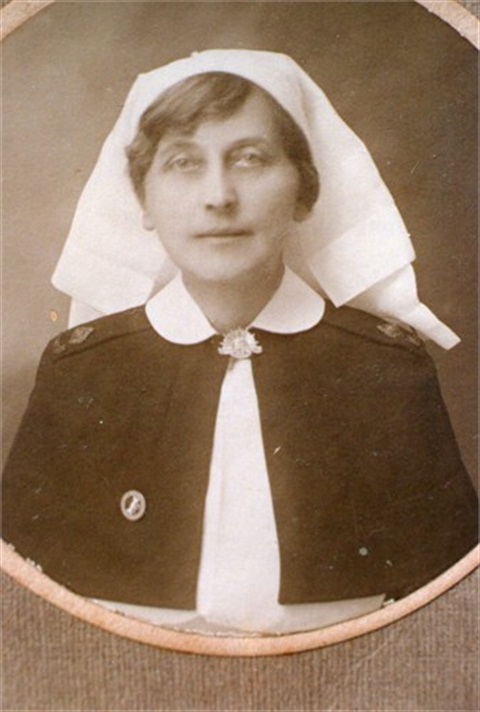
When we commemorate those who served, we remember not only those who fought, but also those who healed.
Among the names on the Kiama Memorial Arch Honour Roll are four women who served as nurses during World War I: Rita Fuller, Kate Gallen, Mary Morton, and Caroline 'Carrie' Whittingham.
These women worked in hospitals and casualty clearing stations across Egypt, England, and France, often under exhausting and dangerous conditions.
Their service came at great personal cost, illness, long separations from home, and lifelong health impacts, yet their contribution saved countless lives and brought comfort to wounded soldiers far from Australia.
A Kiama Independent newspaper article dated 25 March 1916 recorded that Rita Fuller, Kate Gallen, and Carrie Whittingham were all stationed together at the Ghezireh Hospital in Egypt, a rare moment where three Kiama‑connected nurses served side‑by‑side during the war.
Caroline 'Carrie' Whittingham was born 7 September 1870 at St Leonards, the seventh of ten children of Henry and Eleanora Whittingham (née Robinson). Her father, Henry Whittingham, was a banker and served as manager of Kiama’s ANZ Bank, giving the family a strong and well‑known connection to the town.
Carrie trained as a nurse and was appointed Matron of Kiama Cottage Hospital in August 1910, a role she held until her resignation in March 1914. She enlisted with the Australian Army Nursing Service on 9 October 1915 as a Staff Nurse, joining the 2nd Australian General Hospital.
Carrie embarked for overseas service on 10 November 1915 on HMAT Orsova, serving initially in Egypt at the Alexandria Infantry Hospital. By early 1917 she was posted to England and then France, where she worked at the 7th Stationary Hospital (Rouen), 25th General Hospital, and 3rd Casualty Clearing Station, often close to the fighting.
She was promoted to Sister in October 1918. After illness and recuperation at Southwell Gardens, Carrie continued nursing at No. 3 Australian Auxiliary Hospital, Dartford, before returning to Australia aboard HT Nestor on 20 May 1919.
Carrie later married Ivan Francis McCarthy in 1926 and lived in Sydney, and was widowed in 1938. She died on 20 March 1952 in Mosman, aged 81.
Her brother David Whittingham, killed in action in France in 1917, is also named on the Memorial Arch.
Kate Isobel Gallen was born on 4 September 1881 at Shellharbour, the eldest of twin daughters born to John Bernard Gallen and Margaret Gallen (née Thorburn). Kate and her family had long‑standing ties to the Kiama district, where census records show they were living until 1920. Her twin sister, Vida Gallen, also trained as a nurse, and the two sisters passed their nursing examinations together in 1911.
Kate enlisted with the Australian Army Nursing Service on 24 July 1915 as a Staff Nurse, understating her age by more than a decade. Within days she embarked aboard RMS Orontes for overseas service in the Middle East. She nursed at No. 1 General Hospital, Heliopolis, and No. 2 General Hospital, Mena, caring for soldiers evacuated from Gallipoli.
In 1916, Kate was transferred to France, serving at Marseille before being posted to the 2nd Australian General Hospital at Wimereux, close to the Western Front. Early in 1917, she suffered a severe attack of rubella, followed by debility, and was sent to England on medical leave.
While recuperating in England, Kate married Walter Harold Head, a fellow AIF member, in April 1917. As marriage required resignation from the AANS, her service ended on 25 July 1917.
Kate later returned to Australia, continued nursing, and lived in Sydney. She passed away in 1940, aged 59.
Born 4 August 1870, Mary Therese Morton was one of six daughters, three of whom became nurses.
Before the war, Mary was Matron of Camden Hospital, a position she relinquished to enlist on 19 June 1915.
Mary embarked aboard HMAT A67 Orsova on 14 July 1915 and served almost continuously in England. Her postings included War Hospital Norwich, 4th London General Hospital (Denmark Hill), 3rd Australian General Hospital (Brighton), Kitchener War Hospital, and 1st Australian Auxiliary Hospital, Harefield.
Years of exhausting hospital service led to repeated illness, and in late 1917 Mary was admitted to the Australian Nurses Hospital, Southwell Gardens, with a diagnosis of debility. She returned to Australia aboard HT Balmoral Castle on 21 February 1918 to recover.
Although declared fit later that year, Mary was unable to resume nursing at her former capacity. She returned briefly to Camden Hospital before resigning due to ill health. Mary died in 1925, aged 55.
Born in June 1884 at Goulburn, Rita (Marguerite Evelyn) Fuller was the youngest daughter of Thomas John Fuller and Mary Cecilia Fuller (née Kendall). The Fuller family had strong connections to Kiama, having lived there before moving to Goulburn in the early 1880s.
Rita was also part of a prominent NSW family. She was a cousin of Lieutenant Colonel Colin Dunmore Fuller and of Sir George Fuller, Premier of New South Wales, the same Sir George Fuller who unveiled the Kiama Memorial Arch on 25 April 1925, just six years after Rita’s return from war service.
Rita enlisted as a Staff Nurse on 20 August 1915, embarking for overseas service aboard A9 Shropshire with the 2nd Australian General Hospital. She served first in the Middle East, before being transferred to France in April 1916, nursing at Marseille, Rouen, and Wimereux, close to the Western Front.
The physical demands of wartime nursing took a heavy toll. In early 1917 Rita was hospitalised with severe debility (exhaustion), and later treated for chronic middle‑ear disease, leaving her partially deaf. Despite this, she returned to duty and continued working across casualty clearing stations and hospitals in France throughout 1917–1918.
Rita was promoted to Sister on 1 October 1918 and later served at AIF Headquarters in London. She returned to Australia aboard HT Plassy on 5 September 1919, continued nursing, never married, and died in 1978, aged 94.